


Rolex Milgauss: Why the collection falls short of its potential
One thousand gauss, in French mille gauss, is the resistance to magnetic fields of the Rolex Milgauss. Designed in 1956 for engineers or scientists – and thus even before the Rolex Daytona and Sea-Dweller for example – the watch was considered at the time to be the answer to increasingly strong magnetic fields in our ever-developing world.
Despite its more than 60-year history, however, the current collection does not exactly join the ranks of ultra-hyped Rolex must-haves these days, even though it theoretically has everything it takes. Why is that?
A brief historical outline
If a technician in the 1950s were to wear a watch to work, he had to be crazy careful, as magnetic fields of more than 50 Gauss could already ruin a mechanical watch forever. Once the escapement or the oscillator are magnetized, strong rate deviations are almost inevitable and even a complete standstill is possible.
Rolex took this as an opportunity to develop a particularly resistant watch that would easily hold its own in this rapidly advancing world. The decision also makes perfect sense, because just three years earlier the brand had introduced the Rolex Submariner and the Rolex Explorer, two watches that exemplify their genre: the Submariner for divers and the Explorer for adventurers and explorers. Just one year later, in 1954, the first Rolex GMT-Master followed, which is still the quintessential watch for travelers. So the decision to design a separate watch just for scientists was an obvious one.

Although the first Milgauss prototypes were launched in 1954 with the reference 6543, the first official Milgauss was launched in 1956 with the reference 6541. Towards the end of the 1950s, CERN, one of the world’s most prestigious centers for basic physics research, then confirmed that magnetic fields of 1000 Gauss were indeed no problem for the newly presented Milgauss. The secret was a self-developed “protective shield” inside the case, which is made of ferromagnetic alloys and could thus safely house the caliber.
Over the decades, the collection has undergone comparatively few changes by Rolex standards. In 1960, only four years after its original introduction, the reference 1019 was launched and subsequently offered for 28 years. Eventually the entire collection was incinerated in 1988 due to sluggish sales. While Submariner, Daytona & Co. were slowly but safely heading for their current heights, it was time for the Milgauss to say goodbye (for now) after just over three decades of existence.

Resurgence in 2007
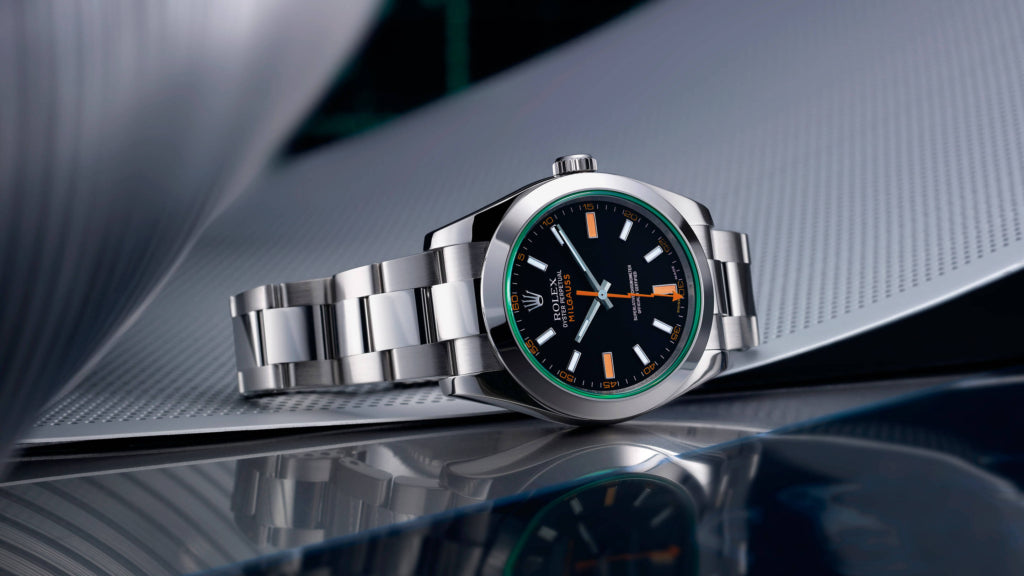
To coincide with Baselworld, a spectacular new edition was launched in 2007 with the Ref. 116400, which for the first time featured a Milgauss element that is typical today: the almost luminous green sapphire crystal. Fun fact: Rolex considers the development of this glass to be so costly and time-consuming that no other watch brand would dare to undertake this odyssey voluntarily. The brand therefore decided not to patent the technology in the first place.

The 904L Oystersteel, which has been used by Rolex since 1985, was also a part of the new reference – an alloy that the reference 1019 did not get to enjoy anymore.
New was also the slightly increased case diameter of 40mm (instead of 38mm) and the return of the signature lightning bolt seconds hand, which was already used on the original Milgauss 1956. Another novelty under the hood was the automatic caliber 3131, which is still in usage to this day. The movement is the ideal choice, given its resistance to magnetic field thanks to the Parachrome hairspring used.

On the occasion of Baselworld 2014, Rolex presented the Milgauss “Z Blue”, whose electro-blue dial works particularly well with the green sapphire crystal. This models represents the last addition to the Milgauss collection.
Frequent points of criticism
Enough of the history lesson and let’s get to the question mentioned at the beginning: Why is the Milgauss not as appreciated today as comparable Rolex stainless steel models à la Datejust or Oyster Perpetual?
For this purpose, we have collected what appear to be the five most common “flaws” or points of criticism:

5. Intended use
The Milgauss sits somewhere between the Air-King, Datejust and Explorer, but we can’t quite put our finger on it. The polished middle links of the bracelet (as known from the Datejust, for example) suggest a certain chic on the one hand, which is quickly made up for again by the quirky second hand and the relatively colorful design. So, if you’re looking for an elegant everyday watch, the Datejust or Oyster Perpetual might be your go-to option. Then again, if you’re looking for a sturdy beater/tool watch, the Explorer is predestined for that.
4. Second hand
You either love it or you hate it: the striking orange second hand in the shape of a lightning bolt. It is deeply rooted of course in the Milgauss collection, since the original reference 6541 already featured it. Nevertheless, given its limited versatility, you really have to be 100% convinced of it before you make a Rolex with a lightning hand your own.

3. Performance
At the time of the Milgauss collection’s launch, the 1000 Gauss were the state of the art. However, this was over 60 years ago and many manufacturers have since passed this mark. A comparable watch would for example be the METAS-certified Omega Aqua Terra (Ref. 220.10.38.20.03.001) with a MSRP of €5,700. Thanks to its Master Chronometer caliber 8800, this watch is insensitive to magnetic fields of up to 15,000 Gauss and thus easily outshines the antimagnetic properties of the Milgauss (at a significantly lower price).
2. Case height
The soft iron cage inside comes at a certain cost of course. Together with the green sapphire crystal, the watch has a height of just under 13.5mm, which can make it feel a bit top-heavy. Even though many owners appreciate the weight on the wrist, the automatic watch builds relatively high by three-hand watch standards. Most Datejust models, by contrast, are around the 12mm mark, the same applies to the Air-King and Explorer.

1. Price
Last but not least, it’s the price that undoubtedly raises a lot of eyebrows. With an MSRP of currently €7,950, you get a three-hand watch that is technologically on par with a Rolex Explorer (€6,200) or a Rolex Air-King (€6,150). The comparison to the Air-King in particular is an interesting one, as the two watches are almost identical in construction, apart from the dial and bracelet. In both cases ticks the caliber 3131 – but once in a 7,950€ watch and once in a 6,150€ watch.
Conclusion
The Rolex Milgauss is an interesting watch, in the sense that it falls through the cracks. On the one hand, it is a nice example of Rolex occasionally loosening its own shirt collar and taking a more unconventional approach.
On the other hand, however, the watch might be a tad too playful and too indefinable for most Rolex beginners to make it their first watch. As a result, the Milgauss strikes us as more of an enthusiast’s Rolex and less of a “I’m looking for my first Rolex” Rolex.
At the end of the day, the Milgauss is in our eyes the perfect watch for those who already own a Rolex and are now looking for a more casual alternative, whose price/performance ratio can be of secondary importance.
Do you have a question about this brand?
Contact us

